
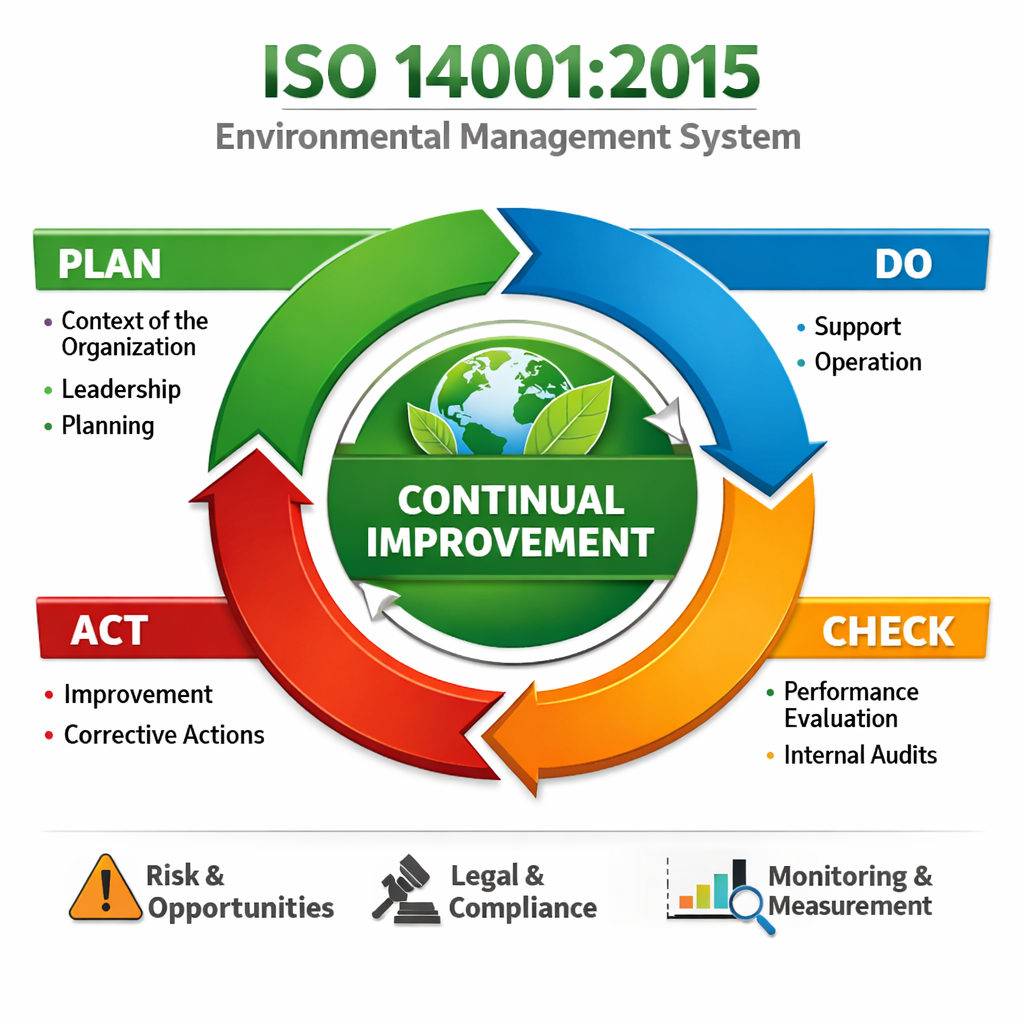

ISO 14001:2026 was just published in April of 2026, with an anticipated 3‑year transition period to ~2029. The focus is on changes summarized below.
 1️⃣ Nature of the Revision (Big Picture)
|
Area |
ISO 14001:2015 |
ISO 14001:2026 |
|
Type of change |
Major structural update in 2015 |
Evolutionary update, not a rebuild |
|
Structure |
Annex SL (10 clauses) |
Same structure retained |
|
Focus |
Compliance + impact control |
Environmental performance, resilience & governance |
|
Integration |
Good alignment with ISO 9001 |
Stronger integration with ISO 9001 & ISO 45001 |
Key message:
If an EMS is working today, it will not be replaced—but expectations for maturity, leadership, and outcomes are higher.
2️⃣ Context of the Organization & Environmental Conditions (Clause 4)
ISO 14001:2015
- Required identification of internal and external issues
- Environmental conditions often treated generically
- Life‑cycle perspective mentioned but loosely applied
ISO 14001:2026
- Explicit consideration required for:
- Climate change
- Biodiversity and ecosystem health
- Pollution and resource availability
- EMS scope must clearly reflect life‑cycle thinking
- Context must be linked to risks, aspects, and objectives
Client impact:
Superficial context analyses will no longer hold up in audits. Auditors will expect a direct line from environmental conditions → risks → actions.
3️⃣ Climate Change (Integrated from 2024 Amendment)
ISO 14001:2015
- Climate change not explicitly stated
ISO 14001:2026
- Fully integrates ISO 14001:2015/Amd 1:2024
- Organizations must:
- Determine whether climate change is a relevant issue
- Consider climate‑related requirements of interested parties
- No requirement to reduce carbon—but proof of evaluation is mandatory
Client impact:
“Not relevant” is acceptable only if justified and documented. Silence is not.
4️⃣ Leadership & Environmental Governance (Clause 5)
ISO 14001:2015
- Leadership commitment required
- Policy and compliance focus
ISO 14001:2026
- Stronger expectations for:
- Leadership accountability
- Conservation of natural resources
- Environmental responsibility across the organization
- Leadership expectations extend beyond top management roles
Client impact:
Environmental management is no longer an “EHS department activity.” Leadership behavior and decision‑making will be evaluated.
5️⃣ Planning, Risks & Change Management (Clause 6)
ISO 14001:2015
- Risks & opportunities addressed
- Change often handled informally
ISO 14001:2026
- Clearer integration of:
- Environmental aspects
- Compliance obligations
- Risks and opportunities
- New emphasis on structured change management (Clause 6.3)
- Emergency preparedness more clearly separated from abnormal operations
Client impact:
Changes to processes, materials, suppliers, or production volumes will require more formal environmental evaluation and follow‑up.
6️⃣ Life‑Cycle & Supply Chain Focus (Clauses 4, 6, 8)
ISO 14001:2015
- Life‑cycle perspective introduced
- Often limited to procurement language
ISO 14001:2026
- Life‑cycle thinking significantly strengthened
- Greater focus on:
- Upstream suppliers
- Downstream impacts
- Value‑chain environmental risk
- Clearer terminology for externally provided processes
Client impact:
Manufacturers will need better visibility into supplier and downstream environmental risks—even without full control.
7️⃣ Performance Evaluation & Auditing (Clause 9)
ISO 14001:2015
- Internal audits required
- Audit objectives often implicit
ISO 14001:2026
- Internal audit programs must include defined objectives
- Management review structure clarified and strengthened
Client impact:
Audits must demonstrate effectiveness, not just compliance. Management reviews must support real environmental decision‑making.
8️⃣ Improvement & Environmental Performance (Clause 10)
ISO 14001:2015
- Continual improvement required
- Performance sometimes measured indirectly
ISO 14001:2026
- Sharper emphasis on:
- Measurable environmental performance
- Learning from incidents, changes, and results
- Less tolerance for static EMS documentation
Client impact:
Organizations must show the EMS drives improvement, not just records it.
9️⃣ What Is Not Changing 
- Annex SL / 10‑clause structure
- PDCA model
- EMS certification framework
- Flexibility in defining environmental objectives
✅ ISO 14001 remains system‑based, not prescriptive—but expectations for credibility are higher.